
As summer transitions into fall, the weather cools, the nourishing plants die away, and the eastern black swallowtail caterpillars form chrysalises that will protect them through the coming snowy winter months. The caterpillars enter a dormant state known as overwintering.
When I began raising butterflies in my backyard, I thought it was a summer project. I had no idea that some butterfly species would be with me year-round. Fortunately, while they are in their chrysalis stage, there isn’t much care that needs to be provided. I simply cleared out some space in my overcrowded garage and moved my butterfly cages inside. Occasionally, I would spray my chrysalises with water to provide the moisture they weren’t receiving from the rain and snow they would have experienced outside.

This spring, though the temperatures in Michigan are still cold, I moved the cages to my patio. They’ve been exposed to the sun, wind, and rain. My family anxiously checks to see if and when the first butterfly will emerge.
So far, May has had a few deceptively hot days sprinkled into a mostly cold season. After months of dormancy, Walker decided May 20 was the day to emerge. It was exciting to suddenly see a butterfly in the cage on our patio. Her wings looked dry, and we wanted to release her so she could get the most out of her short lifespan. Unfortunately, she emerged in a string of days that were in the 40s and 50s. When we took her out of the cage, she didn’t want to fly. But she did walk, thus the name Walker.

We had a conundrum – what to do with a butterfly without butterfly weather. We put her in her own cage and put it back in the garage. She seemed to go dormant again, I think she was in diapause. She didn’t fly, she didn’t move, she didn’t eat from the various flowers and cotton balls of sugar water I placed in her cage. She seemed fine, but was she?
As the weather didn’t improve, we experimented bringing her inside. At first, Walker still didn’t fly, but she let us hold her while she walked. The longer she warmed up inside, she started to take tiny little flights. Butterflies need temperatures above 55 degrees to fly, ideally 70 degrees or higher. We knew warming her up would make her more active, but it wasn’t going to speed up her release date.
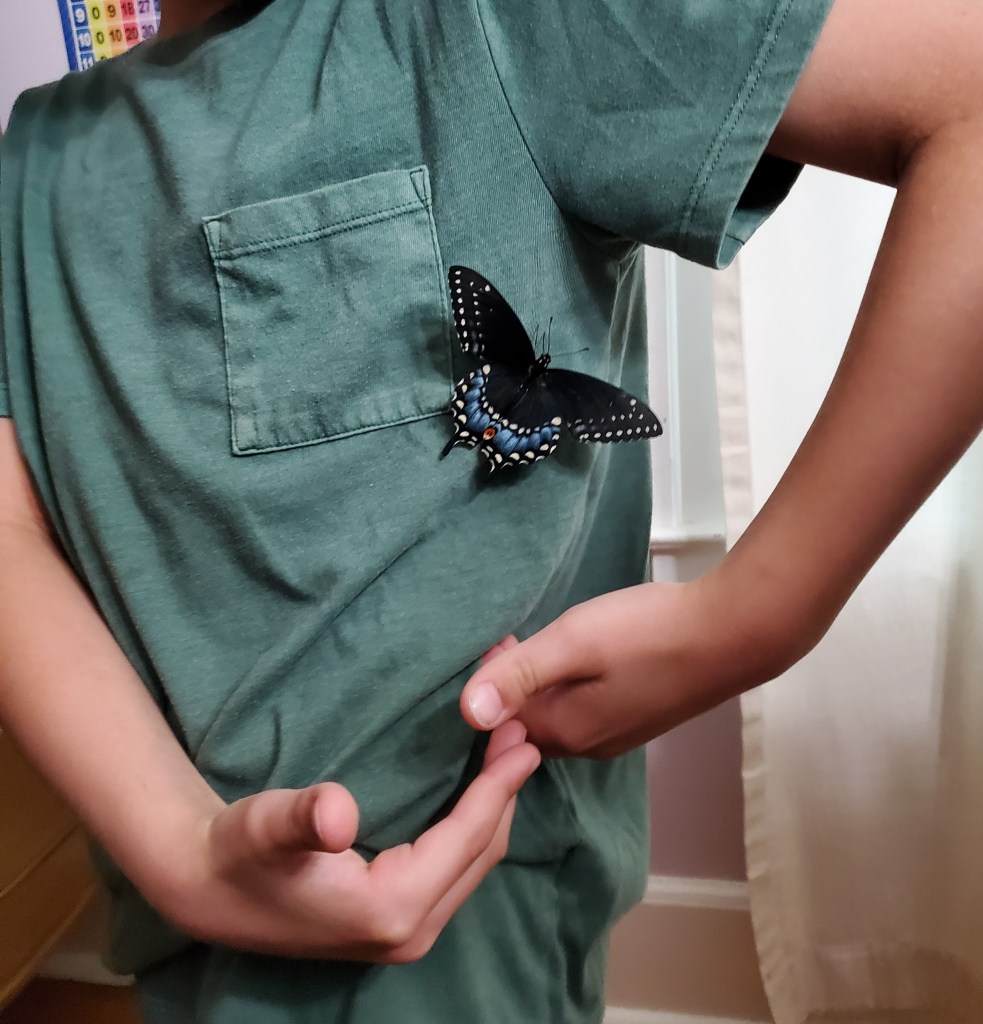
Finally, on May 25, temps got up to 65 degrees, and we saw another female eastern black swallowtail laying eggs outside on our dill. We knew it was time to release Walker and let her start to live her life. We carefully took her out of cage to release her, but she stood still. As the wind gushed by, she clung firmly to my daughter’s hand. She adjusted her wings to become more aerodynamic. She began to pump them. After a minute – an eternity compared to the second you can hold most butterflies – she flew.
It’s still chilly and windy, and I wonder what will become of our girl. I know I protected her just long enough, and now she’s on her own, the way she was meant to be.
To watch Walker’s first flight, visit Raising Backyard Butterflies on Facebook.
Caitlin Gerds Habermas raises butterflies and shares her experiences on RaisingBackyardButterflies.com and social media.
 Raising Backyard Butterflies
Leave a comment